
The housing market is changing across the United States — especially in fast-growing metro areas in Texas like Austin, Houston and Dallas–Fort Worth — builders are facing a very different environment than they experienced during the housing boom of 2021–2022.
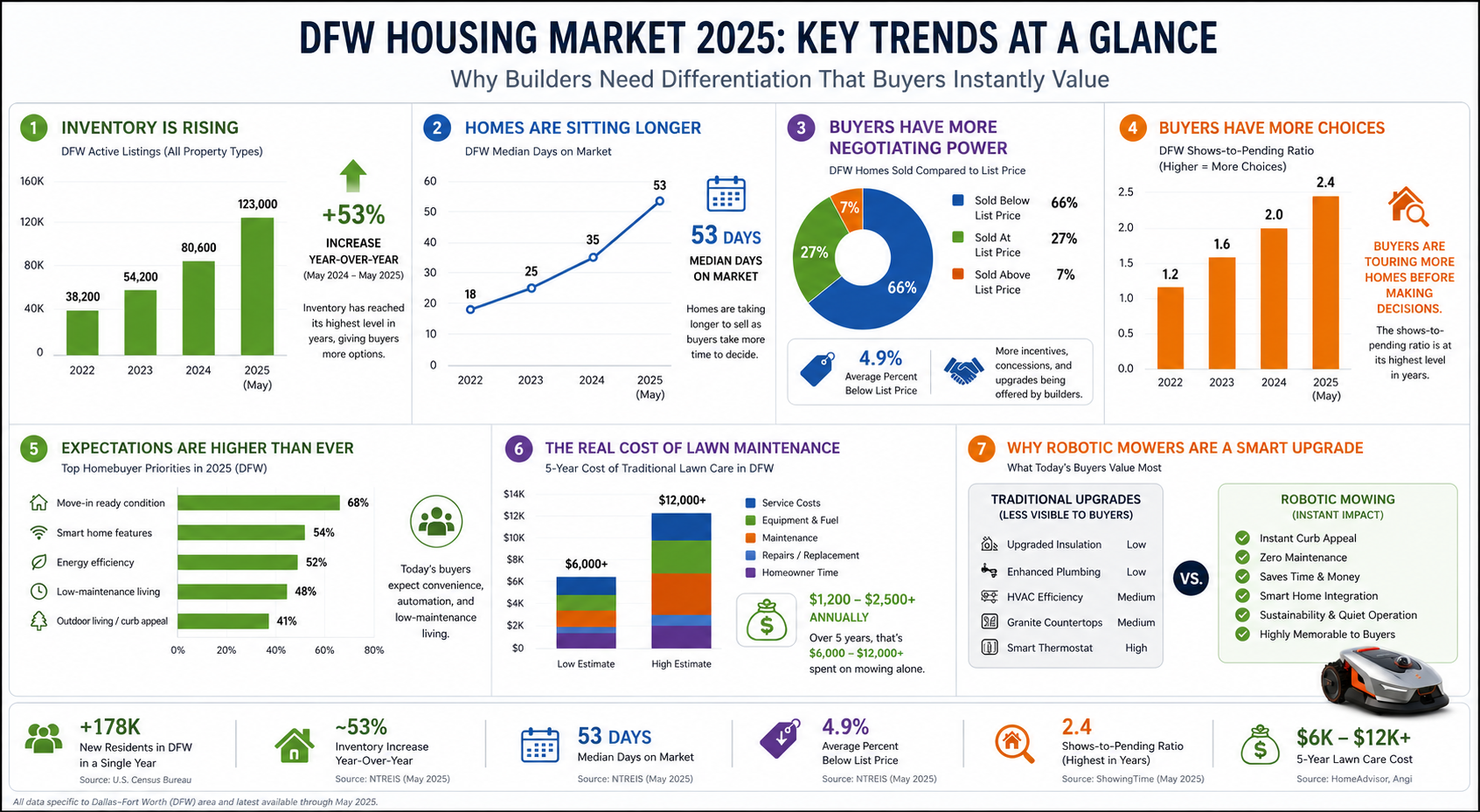
1. Inventory is rising.
2. Homes are sitting longer.
3. Buyers have more choices.
4. And expectations are higher than ever.
That means builders can no longer rely solely on traditional upgrades like granite countertops, stainless steel appliances, or smart thermostats to differentiate their homes.
Today’s buyers are increasingly looking for something deeper:
Convenience. Automation. Reduced maintenance. Better lifestyle experiences.
One overlooked opportunity that checks all those boxes: A Home with an Automatically Maintained Lawn
Why this matters now?
The Dallas–Fort Worth market provides a strong example of where the broader U.S. builder market is heading. According to the U.S. Census Bureau, DFW added approximately 178,000 new residents in a single year, making it one of the fastest-growing metro areas in America.
At the same time:
- Housing inventory across North Texas has increased significantly
- Builders are offering larger incentives to move inventory
- Mortgage rates have reduced buyer urgency
- Buyers are comparing more homes before making decisions
- Smart-home expectations continue rising
This creates a major challenge for builders:
How do you create visible differentiation?
Many builder upgrades are invisible to buyers during walkthroughs.
A buyer cannot immediately “feel”:
- Better insulation
- Upgraded plumbing
- Enhanced HVAC efficiency
- Improved framing quality
But buyers instantly understand:
- Smart lighting
- Smart security
- Automated shades
- Electric vehicle charging
- And now… robotic lawn maintenance
A robotic mower creates an immediate emotional reaction:
“Wait… I never have to mow my lawn?”
That is memorable.
The Builder Market Is Already Shifting Toward Automation
The rise of the smart home is no longer a luxury trend. It is becoming mainstream buyer expectation.
According to Statista and multiple smart-home industry reports:
- The global smart-home market is projected to exceed $230 billion+
- Smart-home adoption continues growing year-over-year
- Convenience and time savings rank among the top consumer purchase drivers
- Younger homebuyers increasingly prioritize automation features
- Buyers are placing greater emphasis on low-maintenance living
Builders have already embraced:
- Smart thermostats
- Smart locks
- Video doorbells
- Connected appliances
- Home automation hubs
Outdoor automation is simply the next evolution.
Why Lawn Maintenance Has Become a Pain Point
Lawn care is one of the most recurring homeowner frustrations. With rising costs in markets like North Texas that have seen relatively lower mowing costs compared to the national average, a robotic mower not only makes sense, but is almost a "must-have" tool when families want to save and at the same time allocate more time to other important tasks.
For many homeowners, mowing is:
- Time-consuming
- Physically demanding
- Expensive
- Difficult to outsource reliably
According to HomeAdvisor and Angi estimates:
- Homeowners commonly spend $1,200–$2,500+ annually on lawn mowing services
- In higher-end communities, costs can exceed $3,000+ per year
-
Over a 5-year period, homeowners may spend:
- $6,000–$12,000+ on mowing alone
And that does not include:
- Fuel
- Equipment maintenance
- Storage space
- Repairs
- Replacement costs
- Weekend time spent mowing
For builders, this creates a powerful value proposition: “This home helps eliminate one of homeownership’s biggest recurring chores.”
That is a message buyers immediately understand.
Why Earlier Robotic Mowers Struggled
Robotic mowers are not new. They have been around since 1995. But earlier generations failed to gain widespread adoption in many suburban U.S. neighborhoods — particularly in Texas.
Common problems included:
- Poor navigation accuracy
- Random mowing patterns
- GPS interruptions
- Difficulty handling narrow side yards
- Weak multi-zone performance
- Inconsistent edge cutting
- Trouble around fences, landscaping, and tight layouts
Many older systems were originally designed for:
- Large European lawns
- Simple open layouts
- Smaller residential properties
Modern American suburban developments — especially in fast-growing metros like DFW — present very different challenges:
- Narrow side yards
- Tight lot spacing
- Complex landscaping
- Multiple lawn zones
- Fence-heavy layouts
- Dense housing configurations
Earlier robotic systems simply were not optimized for these environments.
Why the New Generation of Robotic Mowers Changes Everything
The newest generation of robotic mowers is fundamentally different. Systems like the Sunseeker Elite X4 are specifically designed for modern residential subdivisions and tighter suburban lots.
Key advantages include:
✅ AI-Assisted Navigation
Improved intelligence for handling:
- Narrow passages
- Side yards
- Fence lines
- Obstacles
- Tight transitions
✅ Precise Mowing Patterns
Unlike older random-navigation systems, newer robotic mowers use structured mowing patterns for:
- Better lawn appearance
- More efficient coverage
- Improved consistency
✅ Multi-Zone Capability
Modern homes often have:
- Front yards
- Backyards
- Side strips
- Separate fenced areas
Newer systems manage these layouts far more effectively.
✅ Quiet Electric Operation
Most robotic mowers operate quietly enough to run:
- Early mornings
- Overnight
- During the day without disturbing neighbors
This becomes especially valuable in:
- HOA communities
- Luxury developments
- Dense suburban neighborhoods
- Subdivisions where HoAs are already managing front yards
✅ Compact-Friendly Design
Modern robotic mowers are now practical for:
- Production builders
- Townhome communities
- Master-planned developments
- Luxury custom homes
- Smart-home-focused projects
Why Builders Should Pay Attention
Builders are increasingly competing on lifestyle experience — not just square footage.
Today’s buyer wants:
- Reduced maintenance
- Better technology
- Sustainability
- Convenience
- Time savings
- Premium living experiences
Robotic mowing supports all of these.
The Real Builder Advantage
1. Instant Showroom Appeal
A robotic mower is visible.
Buyers can see it.
Understand it.
Experience it immediately.
That creates stronger:
- Model home engagement
- Demonstration opportunities
- Sales conversations
- Buyer recall
2. Smart-Home Positioning
Builders already market:
- Smart kitchens
- Smart security
- Smart energy systems
Robotic mowing extends the smart-home ecosystem outdoors.
This helps position builders as:
- Technology-forward
- Innovative
- Premium
- Lifestyle-focused
3. Stronger Community Appearance
Consistent lawn maintenance improves:
- Streetscape appearance
- Community aesthetics
- HOA satisfaction
- Neighborhood consistency
This is particularly valuable for:
- Master-planned communities
- Build-to-rent communities
- Luxury developments
4. Sustainability Messaging
Gas-powered lawn equipment faces increasing scrutiny.
The U.S. EPA has reported that gasoline-powered lawn equipment contributes significant localized:
- Emissions
- Air pollution
- Noise pollution
Robotic mowers offer:
- Electric operation
- Reduced fuel usage
- Lower noise levels
- Lower maintenance requirements
For builders increasingly focused on ESG and sustainability positioning, this creates additional marketing value.
5. Competitive Differentiation
Most builder incentives today are financial:
- Rate buy-downs
- Closing cost assistance
- Appliance packages
Robotic mowing creates differentiation that feels:
- Innovative
- Emotional
- Lifestyle-oriented
- Future-focused
It becomes a memorable feature buyers talk about.
Why This Fits Today’s Buyers
Robotic mowing strongly appeals to:
Busy Professionals - Less weekend maintenance.
Dual-Income Households - More convenience and time savings.
Frequent Travelers - Lawn stays maintained while away.
Luxury Buyers - Supports premium smart-home positioning.
Downsizers - Reduced physical upkeep.
Tech-Oriented Buyers - Aligns with connected-home lifestyles.
For many homeowners, the value is not just financial.
It is about:
- Saving time
- Reducing stress
- Maintaining curb appeal automatically
- Simplifying ownership
- Owning a smarter home
Why Builders Need the Right Deployment Strategy
Not all robotic mowers are suitable for:
- Texas heat
- Dense suburban developments
- Builder-scale deployment
- Multi-lot planning
- Complex landscaping
- HOA environments
Choosing the wrong system can create:
- Installation issues
- Mapping problems
- Poor performance
- Negative homeowner experiences
Successful deployment requires:
- Proper product selection
- Site analysis
- Mapping optimization
- Installation planning
- Homeowner onboarding
- Ongoing support
This is where specialized robotic solution partners become critical.
Why This Opportunity Is Bigger Than DFW
DFW is simply an example of a broader national shift.
The same trends are happening across many major growth markets:
- Austin
- Houston
- Phoenix
- Atlanta
- Nashville
- Charlotte
- Orlando
- Tampa
- Raleigh
- Denver
Builders everywhere are searching for:
- Meaningful differentiation
- Smart-home innovation
- Lifestyle-driven upgrades
- Buyer engagement tools
Robotic mowing sits directly at the intersection of all four.
Final Takeaway
The future of smart homes includes smart outdoor automation.
Builders are no longer just selling:
- Floorplans
- Countertops
- Square footage
They are selling:
- Convenience
- Lifestyle
- Automation
- Reduced maintenance
- Time savings
Robotic mowing offers builders:
- ✔ Visible differentiation
- ✔ Strong smart-home positioning
- ✔ Sustainability messaging
- ✔ Better curb appeal consistency
- ✔ Premium buyer perception
- ✔ Everyday homeowner convenience
And newer systems like the Sunseeker Elite X4 finally make widespread suburban deployment practical. The builders who adopt these technologies early may gain an important competitive advantage in an increasingly competitive housing market.
Suggested Sources / References
- U.S. Census Bureau – Population Growth Data
- Realtor.com Housing Market Trends
- Redfin Housing Inventory Reports
- National Association of Home Builders (NAHB)
- Statista Smart Home Market Reports
- HomeAdvisor Lawn Care Cost Reports
- Angi Lawn Maintenance Cost Estimates
- U.S. EPA – Gas-Powered Lawn Equipment Emissions
- McKinsey Smart Home Consumer Research
- Consumer Technology Association (CTA) Smart Home Studies